whatisaheatpump.comFind a local pro
Independent · plain english

What is a heat pump?

A heat pump is one machine that both heats and cools your home. Instead of burning fuel to make heat, it moves heat that already exists, pulling it out of the outdoor air in winter and pushing it back out in summer. That's why it can deliver two to four times more heat than the electricity it consumes.

Estimate my savingsHow it works

No brand sponsorships. No lead resale. Just how the equipment works.

The 20-second answer
01
It replaces two machines
One outdoor unit does the job of your furnace and your air conditioner.
02
It moves heat, it doesn't make it
Moving heat is cheaper than burning fuel, efficiencies of 300–400% are normal.
03
Cold weather is no longer a dealbreaker
Modern cold-climate models keep working well below freezing.

SEER Savings Calculator

rough estimate · not a quote

Tap your area on the map below, or search for your city, and pick the options that match your air conditioner — your estimated annual savings from upgrading to a higher-efficiency system, and how they add up over 5, 10, and 15 years, update instantly.
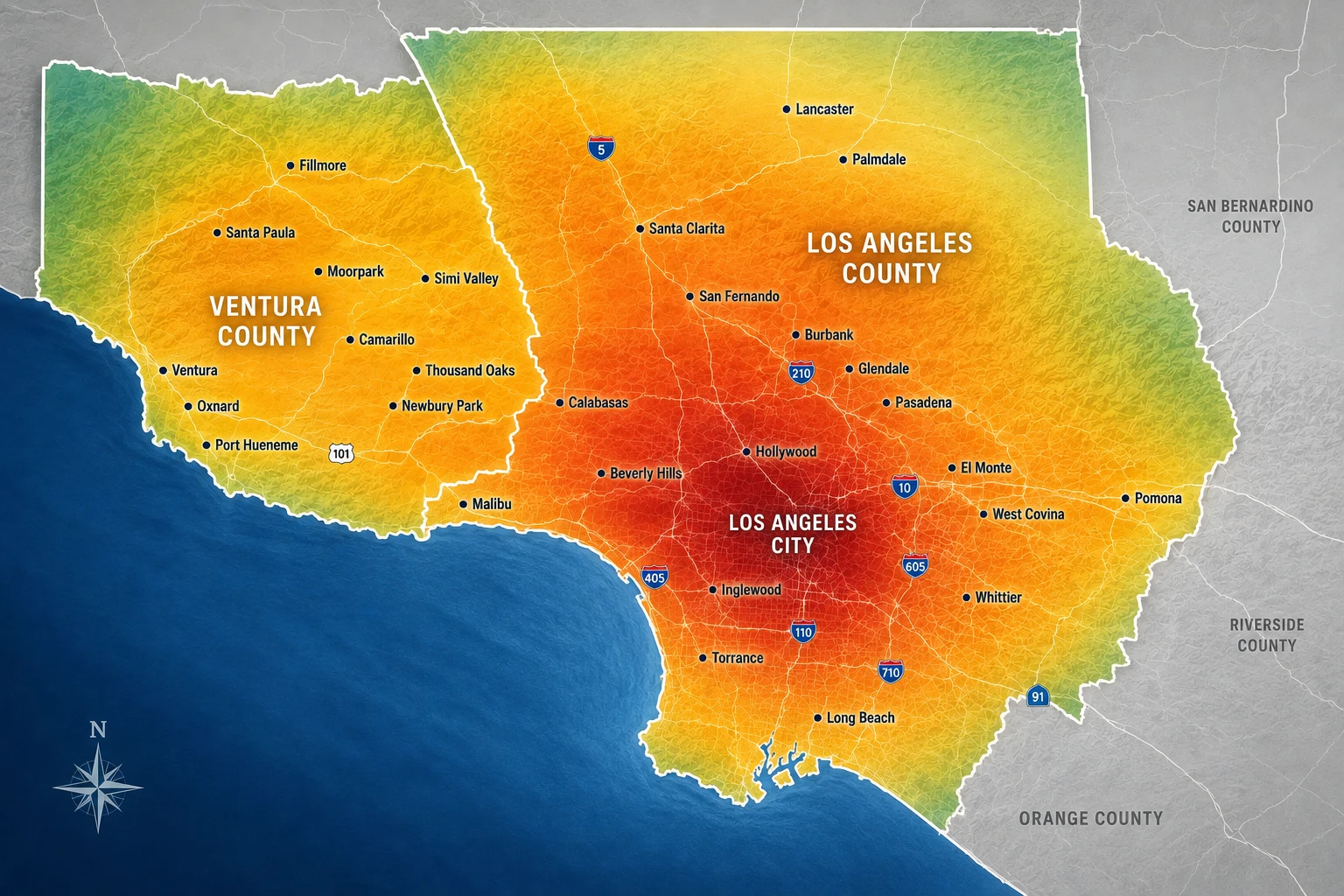
Coverage heatmap across Los Angeles County and Ventura County
Zone 6 — coastal
Zone 9 — LA basin
Zone 14 — inland valley
Tap the map to select your area

SEER Savings Calculator

See how much you could save with a more efficient system.

Your location

Current system

System size3 tons
Current SEER rating
Annual cooling hours hrs/yr
Climate Zones
Electricity rate

New system

New SEER2 rating
Estimated annual savings
$671
47% savings
Current cost
$1,426/yr
New cost
$755/yr
$3,355
5 yrs
$6,709
10 yrs
$10,064
15 yrs

Estimates are based on the information provided and are intended for comparison purposes. Actual energy costs and savings may vary based on ductwork, insulation, system sizing, thermostat settings, weather, home characteristics, and other factors.

Find a local pro for this area

How the calculator works

It builds your annual cooling cost from your air conditioner's actual capacity, not a guessed dollar figure: tonnage × 12,000 BTU/hr × annual cooling hours ÷ SEER, times what electricity costs. It runs that formula twice, once for your current system's SEER and once for the new one, and the difference is your estimated savings.

Then it projects that annual difference forward across 5, 10, and 15 years. Read the full methodology →

Four factors it uses
System size, tonnage, in 12,000 BTU/hr increments
Current SEER rating, the efficiency of the AC you have now
New SEER2 rating, the efficiency of the system you're pricing
Your energy price, cents per kWh where you live

It does not model ductwork, insulation, thermostat settings, or occupancy, all of which can move the real number substantially.

How a heat pump actually works

A refrigerant loop runs between an outdoor unit and an indoor unit. Compressing the refrigerant makes it hot; letting it expand makes it cold. Point that hot end indoors and you have heating; flip a valve and point it outdoors and you have air conditioning.

1
Outdoors, refrigerant absorbs heat
Very cold liquid refrigerant runs through the outdoor coil. Even 20°F air is warmer than that refrigerant, so heat flows into it and it boils into a gas.
2
The compressor squeezes it
Compressing the gas concentrates that diffuse warmth into a small, genuinely hot stream, well above room temperature. This is the only step that uses real electricity.
3
Indoors, it releases the heat
The hot gas passes through the indoor coil, your blower moves house air across it, and the refrigerant condenses back to liquid as it gives up its heat.
4
In summer, the loop reverses
A reversing valve swaps which coil is hot. Now heat is collected from inside your house and dumped outdoors, that is exactly what an air conditioner does.
Heating mode
Outdoors
Outdoor coil
absorbs heat from cold air
20°F
hot gas →
Indoors
Indoor coil
releases it into the house
95°F
COMPRESSOR
← cold liquid returns
expansion valve
Cooling mode
The reversing valve swaps the two coils' roles. The indoor coil now absorbs heat at ~45°F and the outdoor coil dumps it at ~120°F. Nothing else about the machine changes.
Why efficiency can exceed 100%
A furnace can only ever return a fraction of the energy in its fuel. A heat pump isn't converting energy into heat, it's using energy to relocate heat, so one unit of electricity can move three or four units of heat.

The four kinds you'll be quoted

Which one fits depends on whether your house already has ductwork, how cold your winters get, and how much you can spend up front.

Ducted outdoor unit
Ducted air-source
The straight swap if you already have a furnace and ducts. One outdoor unit, one indoor air handler.
Typical: $12k–$20k
Best for: existing ducts
Wall-mounted mini-split head
Ductless mini-split
Indoor heads mounted room by room. No ducts needed, and every room gets its own thermostat.
Typical: $4k–$6k per zone
Best for: no ductwork
Furnace paired with a heat pump
Dual fuel / hybrid
Heat pump handles most of the year; the existing gas furnace takes over on the coldest nights.
Typical: $14k–$22k
Best for: cold climates
Ground loop trenching
Ground-source (geothermal)
Trades heat with the ground instead of the air. The most efficient option and the most expensive to install.
Typical: $20k–$40k
Best for: land + long stay

Heat pump vs. furnace and AC

Where each system genuinely wins. Nothing here is universal, electricity and gas prices in your area decide most of it.

Heat pump
Gas furnace + AC
Equipment needed
One system, heating and cooling
Two systems to buy and maintain
Efficiency
250–400% (COP 2.5–4)
80–98% AFUE, never above 100%
Running cost
Usually lower, unless your electricity is expensive and your gas is cheap
Can win where gas is very cheap
Comfort feel
Long, steady cycles of ~95°F air; even temperatures
Short blasts of 130°F air; warmer then cooler
Very cold weather
Cold-climate models hold capacity to –5°F; below that, backup heat
Unaffected by outdoor temperature
Combustion & venting
None, no flue, no gas line, no CO risk
Flue, gas line, annual safety check
Federal tax credit
Qualifies for the 25C credit
Smaller credit, high-efficiency models only

Decoding the ratings on the label

Every quote you get will be full of acronyms. There are only four that matter, and each one answers a different question.

SEER2
Cooling efficiency
Cooling delivered per watt-hour over a season. Minimum is 13.4–14.3 depending on region; 17–20 is high efficiency.
HSPF2
Heating efficiency
The same idea for the heating season. 7.5 is the federal floor for split systems; 9–11 is the premium tier.
COP
Efficiency right now
Heat out ÷ electricity in at one specific outdoor temperature. COP 3 means 300%. It falls as it gets colder outside.
Tons
Capacity, not weight
One ton = 12,000 BTU/h. Sizing should come from a Manual J load calculation, not a rule of thumb.
Rough capacity by home size
A sanity check on a contractor's proposal, not a substitute for Manual J.
Square feet
Size
750 – 1,000
1.5 – 2 tons
1,050 – 1,400
2.5 tons
1,450 – 1,700
3 tons
1,750 – 1,900
3.5 tons
1,950 – 2,200
4 tons
2,250 +
5 tons
Three things that quietly ruin efficiency
Mismatched indoor and outdoor units
Ratings are earned by a specific pair. Mix and match and you won't get the number on the label.
Oversizing
A too-big system short-cycles: worse humidity control, more wear, no efficiency benefit.
Leaky or undersized ducts
Duct losses of 20–30% are common in older homes and wipe out most of an efficiency upgrade.
Money on the table

Rebates and credits change the math completely

Federal, state, and utility programs stack. Between them, a $16,000 install can land closer to $9,000, which is usually the difference between a heat pump being a stretch and being obvious.

Check programs in my ZIP
Federal 25C tax credit
30% of project cost for qualifying heat pumps, claimed on your return.
up to $2,000
State point-of-sale rebates
Income-qualified programs administered state by state; amounts and status vary.
up to $8,000
Utility incentives
Per-ton or flat rebates from your electric utility, often with a contractor requirement.
$300 – $3,000

Program rules and funding change. Always confirm current terms before signing a contract.

Keeping it running well

A heat pump runs year-round, so it accumulates roughly twice the hours of a furnace. Maintenance matters more, and most of it is filter discipline.

Changing an air filter
Monthly
Look at the filter
Replace it when light no longer passes through. A clogged filter is the single most common cause of a "broken" system.
Seasonally
Clear the outdoor unit
Two feet of clearance on all sides. Rinse leaves and grass clippings off the coil; keep snow and ice clear of the base in winter.
Twice a year
Professional service
Once before heating season, once before cooling. Refrigerant charge, coil cleaning, electrical connections, condensate drain.
Call someone
Ice that never melts, or air that never gets warm
Brief frost and a defrost cycle with steam are normal. Persistent ice, a unit that runs constantly, or breakers tripping are not.

Articles

All articles →

Longer pieces on the questions that come up after the calculator, cold-weather performance, what a fair quote looks like, and the mistakes that cost people money.

Do heat pumps actually work when it's below freezing?
Cold climates·11 min read

Do heat pumps actually work when it's below freezing?

Short answer: yes, with field data from Maine and Minnesota to prove it. The real question is your balance point, and why backup heat is what ruins the bill.

How to read a heat pump quote line by line
Buying

How to read a heat pump quote line by line

The four line items that should be on every heat pump quote, in writing, and the three red flags that mean you should get another bid before signing.

Why an oversized system feels worse, not better
Sizing

Why an oversized system feels worse, not better

Short cycling, clammy summers, and premature compressor failure all trace back to the same sizing mistake most contractors still make by rule of thumb.

My bill went up after switching. What happened?
Costs

My bill went up after switching. What happened?

A higher bill after switching to a heat pump is usually one of five things, and four of them are fixable fast without touching the equipment itself.

Regional note

Southern California is close to the ideal case for a heat pump

Mild winters mean the system almost never drops into backup heat, and the long cooling season means one machine earns its keep year-round. Local complications are different here: Title 24 compliance, permitting, and older homes with undersized or leaky ductwork are the things worth asking a contractor about.

Ducted or ductless: which one for your house?
Equipment·7 min read

Ducted or ductless: which one for your house?

A decision tree for ducted vs. ductless heat pumps, based on what your house already has, your budget, and your layout, not on which is newest.

Stacking the 25C credit with state and utility money
Rebates·9 min read

Stacking the 25C credit with state and utility money

How to stack the Federal 25C tax credit with state and utility rebates: the order you apply in, and the program rules that quietly disqualify each other.

Steam, frost, and noise: what's normal and what isn't
Maintenance·5 min read

Steam, frost, and noise: what's normal and what isn't

A field guide to the steam, frost, and clicking sounds a heat pump makes in winter: which are completely normal, and which mean call a technician.

Stop setting your thermostat back at night
Comfort·6 min read

Stop setting your thermostat back at night

Setting the thermostat back overnight saves money with a furnace, but with a heat pump it often backfires by triggering expensive backup heat instead.

Questions people actually ask

All FAQs →

Straight answers, including the ones where the honest answer is "it depends."

Will a heat pump keep my house warm in a cold snap?
A cold-climate model holds most of its rated capacity down to about 5°F and keeps producing heat well below zero. What matters is the balance point: the outdoor temperature where the heat pump can no longer keep up alone. A properly sized system in a properly insulated house puts that point below your typical winter low.
Do I have to give up my gas furnace?
No. A dual-fuel setup keeps the furnace as backup and lets the heat pump handle everything above the switchover temperature. In cold regions with cheap gas this is usually the lowest-cost option, and it means you never lose heat if one system fails.
Why does the air feel cooler than my furnace?
Because it is. A furnace blows air at roughly 130°F in short bursts; a heat pump delivers around 95°F for much longer stretches. Skin temperature is about 92°F, so heat pump air can feel neutral even while the room holds a steadier temperature than a furnace ever managed.
How long do they last?
Fifteen years is typical, twenty is common with maintenance. A heat pump runs year-round rather than seasonally, so filter changes and annual service matter more than they do on a furnace. Compressor failure is the expensive one; most other repairs are modest.
Do I need to upgrade my electrical panel?
Sometimes. A typical whole-home heat pump needs a 30 to 60 amp circuit. Many 100 amp panels can absorb that, especially with a load calculation or a smart splitter. Budget $2,000 to $4,000 if a service upgrade is genuinely required, and ask about it before you sign.
Is it worth replacing an AC that still works?
Usually not on its own. The economics work best when something is already failing, or when a refrigerant phase-out makes repair expensive. If your AC is over twelve years old and your furnace is near the end of its life, replacing both with one heat pump is the cheapest moment you will get.
Next step

Get a load calculation before you get a quote

The single best predictor of whether you'll be happy with a heat pump is whether it was sized properly. Ask any contractor for a Manual J calculation in writing, a good one will offer it before you ask. Tell us your ZIP and we'll point you to a resource for finding one, and pass along your notes.

Questions to ask them

Opens your email client addressed to hello@whatisaheatpump.com. We don't sell or resell this to contractors, a real person reads it and points you to a resource we'd actually recommend.