SEER Savings Calculator
See exactly how much a higher-efficiency air conditioner or heat pump could save you, and how SEER and SEER2 ratings actually get calculated underneath the marketing numbers.
SEER Savings Calculator
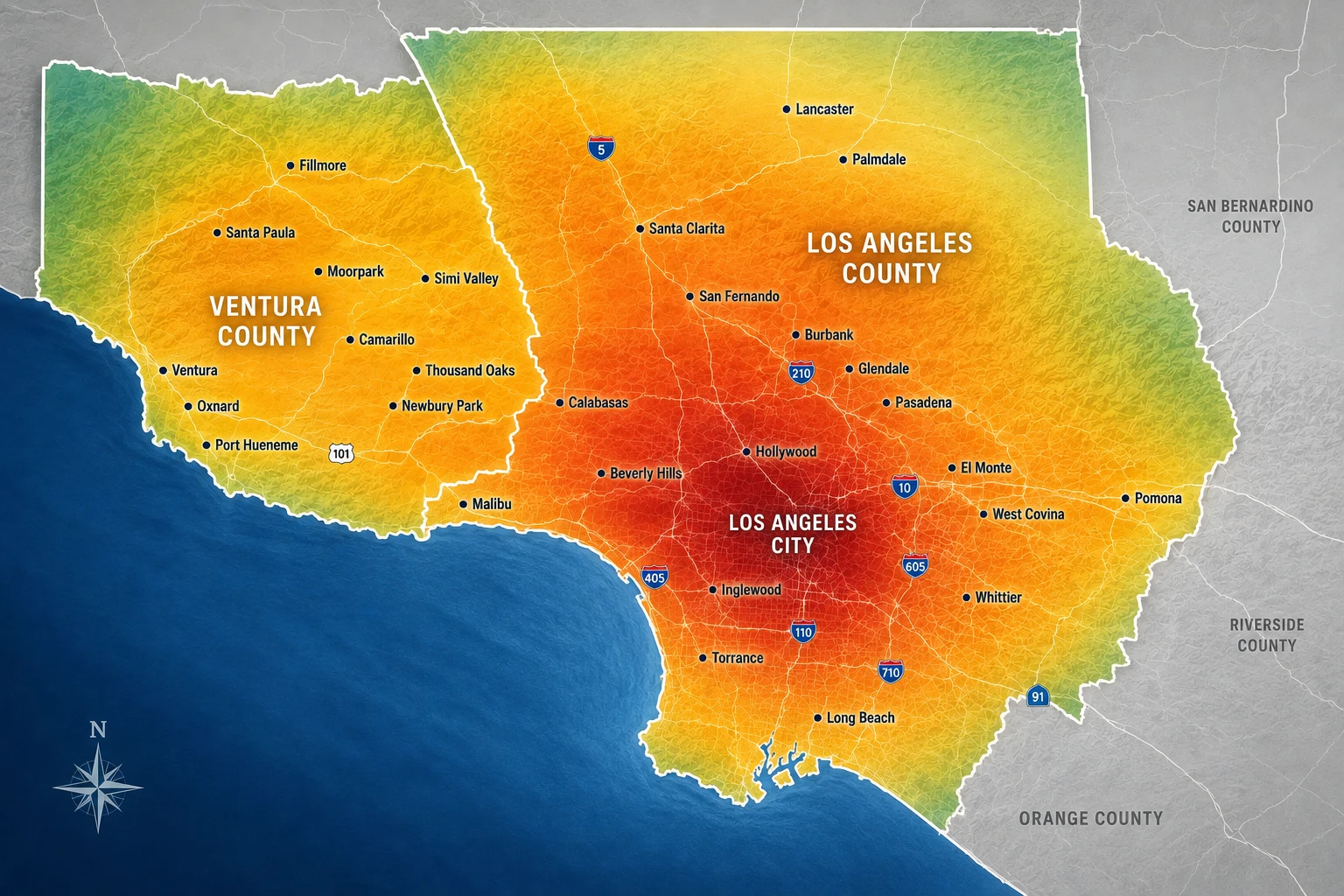
Tap your area on the map below, or search for your city, and pick the options that match your air conditioner — your estimated annual savings from upgrading to a higher-efficiency system, and how they add up over 5, 10, and 15 years, update instantly.
SEER Savings Calculator
See how much you could save with a more efficient system.
Current system
New system
Estimates are based on the information provided and are intended for comparison purposes. Actual energy costs and savings may vary based on ductwork, insulation, system sizing, thermostat settings, weather, home characteristics, and other factors.
Find a local pro for this areaHow does this calculator work?
The estimate is built from your air conditioner's actual cooling capacity, not a guessed dollar figure. First, it calculates your annual cooling cost from four factors: the SEER rating of your current air conditioner, its size in tons, the cost of electricity per kilowatt-hour where you live, and how many hours a year your system typically runs.
Annual cost = (Tonnage × 12,000 BTU/hr × Annual cooling hours ÷ SEER) × Electricity rate
That formula runs twice, once for your current system's SEER rating and once for the new one, and the difference is your estimated savings, shown per year and as a running total over 5, 10, and 15 years. New systems rated in SEER2 are converted to an SEER-equivalent basis first, so the comparison stays apples-to-apples.
What is SEER and SEER2?
SEER — Seasonal Energy Efficiency Ratio — is the rating system for air conditioner and heat pump cooling efficiency. The higher the number, the less electricity the system consumes to deliver the same amount of cooling.
SEER2 is the current version. It replaced SEER as the standard for all air conditioners and heat pumps manufactured from January 1, 2023 onward.
How are SEER and SEER2 calculated?
Both use the same basic formula: the total heat removed from a home during a typical cooling season (in BTU), divided by the total electrical energy the system used over that same season (in watt-hours). The difference between SEER and SEER2 is in the testing procedure, not the formula. Starting in 2023, manufacturers had to test units under higher external static pressure, conditions that more closely match how a system actually performs once it's installed with real ductwork attached, rather than in an idealized lab setup.
That more realistic test procedure produces a rating that runs about 4.5% lower than the same physical unit would have scored under the old SEER test, which is why a SEER2-rated system is roughly 4.71% more efficient than a SEER-rated system carrying the identical number. It's not quite an apples-to-apples comparison, which is exactly why the calculator above converts SEER2 to an SEER-equivalent value before comparing it against your current system.
A note about HSPF and EER
Two other efficiency ratings you may run into: HSPF (Heating Seasonal Performance Factor), which rates a heat pump's heating-side efficiency the way SEER rates its cooling side, and EER (Energy Efficiency Ratio), which measures efficiency at one fixed outdoor temperature (95°F) rather than across a full season. Both were updated to HSPF2 and EER2 alongside the SEER2 transition. Neither factors into this calculator, but you'll see them listed on an efficiency label or spec sheet, especially for heat pumps. See decoding the ratings on the label for how HSPF2 fits into heating-side costs.
What are the current AC efficiency standards?
Minimum efficiency standards took effect January 1, 2023, and they vary by region. The DOE splits the country into three zones, North, Southeast, and Southwest, with the Southwest zone (Arizona, California, Nevada, New Mexico) carrying the highest minimum.
Source: U.S. Department of Energy minimum efficiency standards, effective January 1, 2023. Heat pumps and single-packaged systems in the Southeast/Southwest are instead governed by regional EER2 minimums, not shown here.
If your current system predates these standards and doesn't meet them, that's fine, you don't have to replace a working system. The rule only kicks in when a contractor installs new equipment.
How do I find my AC's SEER or SEER2 rating?
- Check your outdoor condenser unit first, most have a yellow Energy Guide sticker on the side listing the SEER rating and other specs.
- If that sticker is faded or missing, check the air handler, usually in a closet, attic, or garage, which often carries the same information.
- No luck either place? Find the manufacturer name, model number, and serial number stamped on the unit and look them up on the manufacturer's website, or call their customer service line.
Mismatched systems
A condenser and air handler have to be a matched, manufacturer-approved pair to actually hit the SEER rating printed on the label. Contractors are supposed to install matched sets, but it doesn't always happen, if yours is mismatched, real-world efficiency will run below what the label promises, which is one more reason this tool gives an estimate, not a guarantee.
What this estimate doesn't account for
- Whether your current system is actually correctly sized for your home in the first place
- Duct leakage or airflow restrictions, which can quietly cost more than a SEER upgrade saves
- Time-of-use electricity pricing, where afternoon and evening rates run higher than the flat average used here
- Insulation, window efficiency, and shading, which all affect how hard the system has to work
Those factors can move the real number up or down meaningfully. A proper load calculation and a well-maintained system matter as much as the rating on the label.